.png?v=a2f20dcdf5)
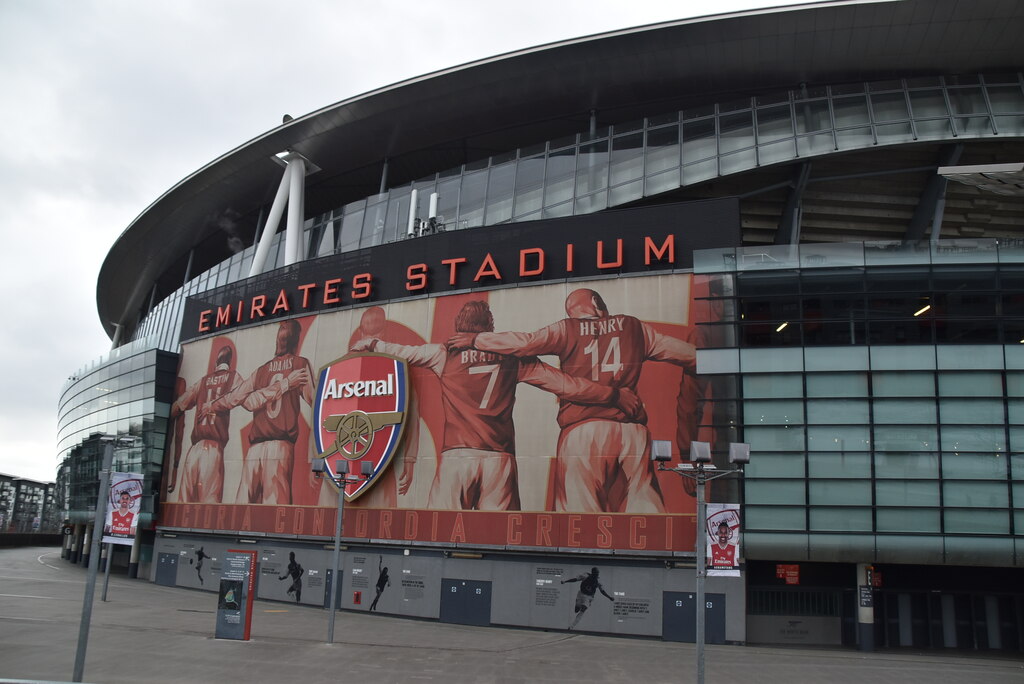

Twenty years ago this May, Arsenal played their last match at Highbury and moved four hundred yards down the road to a stadium built, in effect, to solve a problem that had nothing to do with football. Capacity at Highbury had been capped under 40,000 since the North Bank rebuild in 1993, gate receipts were falling behind United's after Old Trafford's expansion, and the club needed a bigger room to survive in the new financial century. The Emirates was the answer to that arithmetic. It was never designed to answer the other question, which was whether Arsenal would still be Arsenal once they got there.
Twenty years and 500-odd home matches on, the numbers are in and they are, by any honest reading, decent rather than glorious: 336 wins from 500, a 67.2% win rate, 1,066 goals scored at better than two a game. That is a genuinely strong home record, the kind a lot of clubs would sign for gladly, and anyone arguing the Emirates has been a footballing failure should sit with those figures before they open their mouth. Wenger's unbeaten side of 2007/08 played there. Emery's autumn of 2018 ran to 13 without defeat. Arteta strung together sixteen unbeaten across 2024 into January 2025. This has not been a barren stadium.
But dominance was the word on the tin, and dominance is not what got delivered. The move was sold, implicitly if not explicitly, as the platform for exactly the kind of period Chelsea and then City went on to have, a period of trophies stacking up because the financial ceiling had finally been raised. Instead the club spent the first decade of the Emirates paying the Emirates off. Wenger said it plainly in 2016: the banks needed technical consistency to guarantee they'd get their money back, three Champions League campaigns in five years minimum, average gates around 54,000. That is not a football man talking about football. That is a football man talking about a mortgage, and for the better part of ten years the mortgage came first, squad strengthening deferred, players sold rather than replaced, ticket prices rising while the debt got serviced in the background. Fans felt that decision before they understood it. You could see it in the sales, the RVPs and the Nasris and the Song, each one a name and a number that made sense on a spreadsheet in a way it never did in the away end at three o'clock.
The strongest case against me is not complicated and it's mostly correct: without the stadium there is no modern Arsenal at all, just a well-run museum piece slowly priced out of its own division. The revenue the Emirates generates now funds the wage bill, funds Kroenke's stated ambition to push capacity past 70,000, funds a version of Arsenal that can at least compete for the players it wants rather than the players it can afford. Highbury romantics, and I include myself in the diagnosis if not the sentence, sometimes talk about the move as a kind of original sin. It wasn't. It was a survival decision taken by grown-ups, and the grown-ups were mostly right about the economics.
What they didn't manage, and perhaps couldn't have, was the emotional ledger alongside the financial one. The club asked supporters to trade a ground where you could hear individual voices for a bowl where the acoustics swallow them, and it asked for that trade on the promise that silverware would follow soon enough to make the noise irrelevant. It didn't arrive on schedule. Seven trophyless years between 2005 and 2014 sat right in the middle of the debt-repayment period, and no amount of category-one academy talk fixes the feeling of watching your best players sold every August to service a stand you're sitting in.
The expansion plans due to mark this anniversary, steeper tiers and more seats and 70,000 eventually, read like the club doing the same thing again with better information. Fine. But Josh Kroenke's stated wish to bring something of Highbury's character into that redevelopment is the interesting bit, because it's an admission, however lightly made, that the first twenty years optimised for the wrong column. You don't try to restore character in a building unless you've noticed it left.
The bloke behind me put it simpler than any of this last season, somewhere around the hour mark of a match we were winning comfortably and enjoying not at all. "I don't come here to watch a business do well." He wasn't being clever. He meant it the way you mean something you've been chewing over since roughly 2011.
So call the next decade something other than a chase for dominance, because dominance was always somebody else's word for what a football club is supposed to do, borrowed from boardrooms that measure success in market share. Success for Arsenal over the next twenty years should mean a ground that sounds like it means it and a squad built from a philosophy rather than a repayment schedule, with trophies as the proof of that identity rather than the entire point of it. The Emirates got the club solvent. It's taken twenty years to admit that solvency was never going to feel like belonging on its own.